Repurposing Technology: Sculpture and Interview with Chris Combs
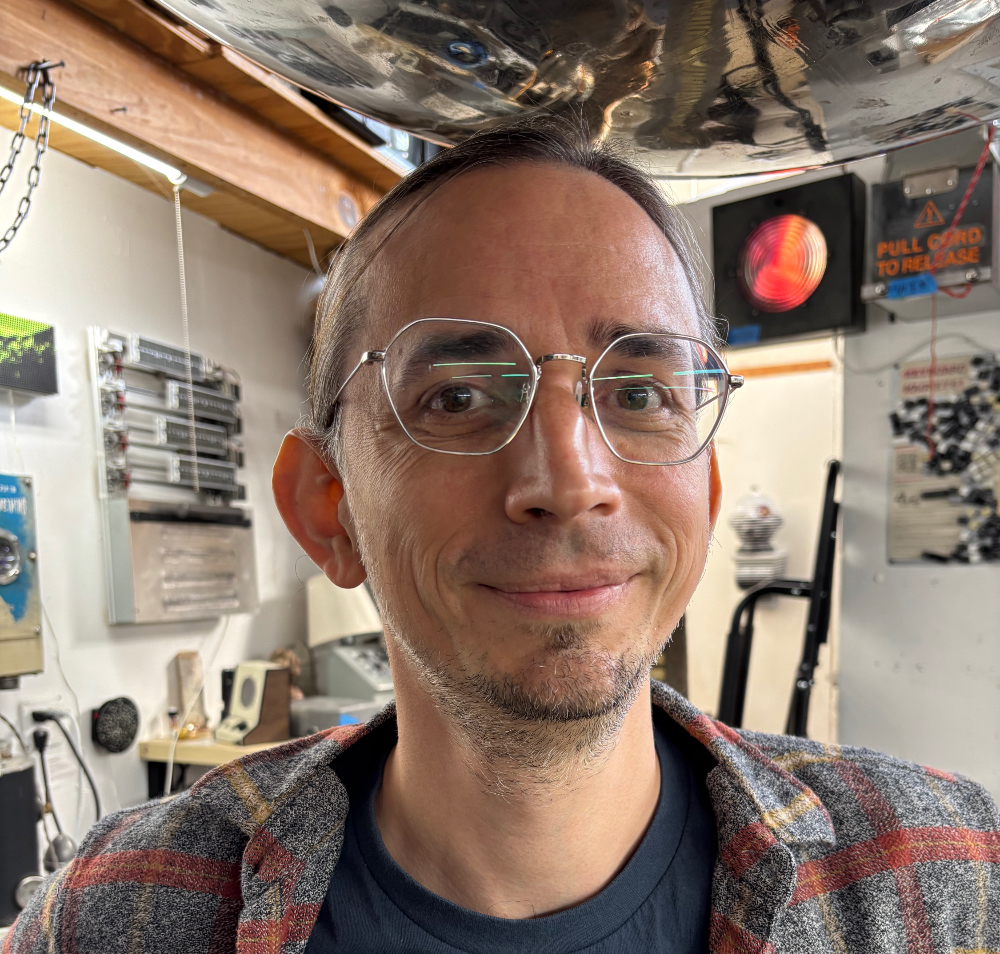
We recently visited the studio of sculpture artist Chris Combs, who focuses on interactive works at his gallery in Mount Ranier, Maryland. Below you will find a sampling of his art work alongside a condensed version of our interview. For our full conversation with Chris, check out the audio file at the bottom of the page.

L&T: One of the things we were talking about is that a lot of your catalog requires the audience to not only view technology but to interact with it. What are you looking for in that dialogue between art and audience, or between technology and audience?
Combs: In my head, there's a fun speed bump to get over. Often my work is in a gallery, right? So, you're in an art gallery. You're looking at artwork on the wall or on a pedestal. you're not supposed to touch it, and I'm asking you to. There's a label next to it that says, "go ahead, touch the artwork.” There’s a bit of a speed bump for you to get over there. In and of itself, that's just like a little narrative that I get for free as someone who has art that you're supposed to touch. I get to ask for that start of your fear, and then the middle of you starting to do the thing, and then the end of doing the thing. And that's before I even get to the things I want to say. It's fun. It's free. I love it. When I am having some interaction in my artwork, some high-minded thing, maybe in my head, where I'm like, commenting on some big problem in the world, I don't know if that always gets through, but I do think that what gets through is someone doing something and seeing a response.

L&T: We had the opportunity to get that response in person here with the piece "Refugium (Pahrump Poolfish.)" In it, you give the viewer direct control over nature through machines. Can you talk more about this experiment? In what ways do you see technology assisting or impeding survival?
Combs: Maybe the issue that we're dancing around is inevitability, or the portrayal of inevitability. AI is a great example of this. GenAI hype is at an all-time peak as of this moment. And it's portrayed by its boosters as being something inevitable… And there are other things that probably are inevitable, like the extinction of the Pahrump Poolfish, that we are told are not necessarily inevitable or that we can at least delay it, or slow it down enough to do something about it. Maybe we truly could fix it. I don't know. The flip side of inevitability is control. If something is possible, then you have control over whether it happens or not. If something is inevitable, you have no control. To my mind, interactive electronics or sculptures, or things you can touch or play with, that is the sort of question of control. I get to play with control as a paintbrush. It lets me question and probe these issues like the inevitability, or not, of a little uncharismatic fish going extinct. I feel like any sort of lever or control that I have, it's something that I can be conscious about.
L&T: Your work often repurposes a utilitarian technology to new ends, that changes our sense of how we're controlling that technology. To what extent does medium or the material that you pick up control the message? How does that dictate the function of a particular piece?
Combs: I try to separate the materials of an artwork from the tools or techniques that it employs. So, the materials might be the instrument case, the big metal box that makes up this artwork. But then the technique might be that you can turn a knob, and it changes this video screen. The meaning of it is yet a third thing for me. So, the meaning of it, in this case, is about this little critter’s last refuge on the planet. So, I think of these things and deal with them, completely separately. They're all three kind of aspects that I combine, at the last minute often, to make a given artwork.
L&T: Your art has found homes in a variety of places: in the lobby of an Amazon building, as a public art display in DC, and beyond. How do you feel the location of a given piece changes its meaning or potential interpretations?
Combs: Context is another paintbrush, right? If you encounter something outside in the woods, it's very different from if you encounter something outside on a sidewalk. This artwork here with the board was in the woods for 3 months, and it's designed for that. Putting in a gallery, it doesn't strike you in the same way. We’re just such creatures of context. It’s easy to forget that in a gallery. It’s got to be white walls. You must have the label next to it. None of those are true. You don't have to have it on the wall. You don't have to have a white wall. These are all contexts that are important for viewers, whether they realize it or not. That's a tool that you have as an artist. Art that's outside of the gallery can sometimes be even more powerful, I think, because it's a bit surprising to find art in your daily life. My outdoor piece is just in a breezeway in an apartment development. And as you're walking along, you see a pipe and you're like, "Okay, that's a pipe. Got it." Keep walking. You look at the pipe again. Maybe as you're walking by, you're like, "Wait, there's like a screen on there?" I enjoy that. I think that it makes you treat it differently. It might make you treat it less preciously if you find something in the woods, or on your walk, or something like that, which can be helpful. Not everyone wants to be bothered with the sort of friction of going to a gallery and having to comport with their expectations and be very quiet and look at the stuff carefully and not touch it. I want to break all those rules.

L&T: A lot of your pieces are interested in some type of analog experience. We have control, or the illusion of control, over something analog, often nostalgic. You shift our understanding of that nostalgia. There's something that the old piece of technology is doing differently than what we would expect.
Combs: For me, playing around with timelines is part of highlighting the changes. So, for instance, I have an artwork called "Morale is Mandatory" that is set in a 1940s era case, but it has new facial recognition hardware in it that's looking for your face and running an AI model to see whether it thinks you're happy or not. By playing with the timeline in that way, I am thinking about what it would have been like if there had been facial recognition for all this time and to ask, would that be good? Maybe not. What is it going to be like 80 years from now, when we have this level of routine surveillance? I don't know if it's necessarily a good thing. By playing with timelines, by making something look visibly old, but then do something new, I hope to bring viewers into a bit of that space of thinking about time and thinking about change. So often, we think of older things nostalgically, we put them in a favorable light. I am doing the opposite by putting these newer things in a less favorable light by making them look older.

L&T: In a previous interview for the Art Clinic Online, you mentioned that you make art that "does what it wants." How do you get your work to assert agency over the viewer?
Combs: I think that art should be asking questions instead of answering questions. For me, a way of doing that by having an artwork like the Uncontrollable Light. Maybe it is doing exactly what I ask it to do, but the thing that I'm asking it to do is not what you, the viewer, expect. It’s playing with that expectation a bit but also making it a bit more random. It's so easy for us to imagine intelligence or agency on the part of an inanimate object. I want you to think this artwork has some kind of mind of its own, and it's doing something that you can't really control, because it'd be boring if you could control every aspect of it. In general, when I speak of these attributes of an artwork doing what it wants, they tend to be just informed by randomness. I might have like a 60-minute-long looping video which no one will sit through 60 minutes of. You look at an artwork for 10 seconds. That 10-second span that you get is very different from someone else's. And that's enough for me. That's the whole experience with "Periscopes," these outdoor public artworks. You're not going to sit there and watch all the whatever 90 minutes of footage, and I don't want you to. I want you to get a taste of it. And maybe get a different taste when you walk by every time.
Listen to the full interview below:

Chris Combs is an artist based in Washington, D.C and Mount Rainier, Maryland whose sculptural artworks both incorporate and question technologies. He was the 2025 artist-in-residence at the Sanford Underground Research Facility, and is a five-time recipient of the DC CAH Arts and Humanities Fellowship. Before becoming an artist, he was a photojournalist, a photo editor for National Geographic, a product manager, and ran a media website. As a kid, he wanted to make robots; many years later, he looped back to this. His artwork often incorporates his own videos of natural places.


