Thoughts on the Present State of American Affairs: Excerpts from Common Sense (Poetry)
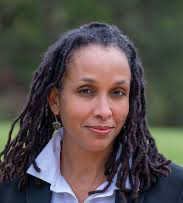
Crystal Simone Smith


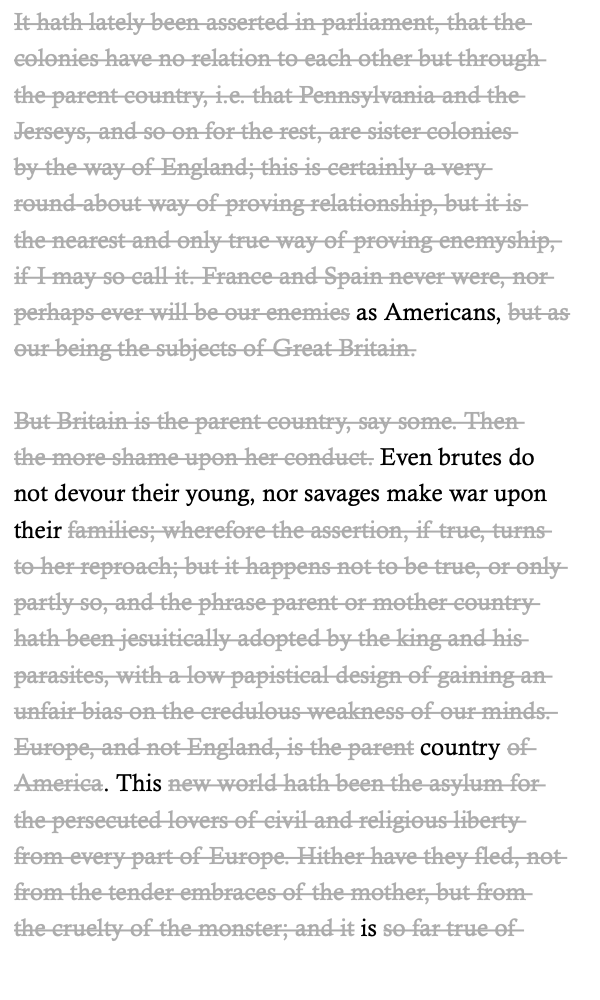


Below you will find our interview with author, educator, and indie publisher Crystal Simone Smith. Her erasure collection, Common Sense, will be published by Penguin Random House on March 24th, 2026.
L&T: Your forthcoming collection reframes the work of revolutionary and political pamphleteer Thomas Paine. When did you first encounter Common Sense? Upon revisiting Paine’s writing, what struck you? Why does this source seem ripe for reinvention in the here and now?
Smith: I encountered Common Sense several years ago prepping for an American Lit course. I wanted to capture the wide breadth of our voices beginning with the early documents composed mostly of political writings. It's one of those documents you know exist, but have little reason to read because, like other foundational documents, it accomplished its timely purpose in establishing our nation. Once I settled into the old world, King's English that permeates it, I found the dense rhetoric, impassioned but deeply hypocritical. In the history of our nation, Paine's Common Sense is the most resolute document we have to decode oppression. It is nearly fifty pages of scathing condemnation that reveals white men did not want monarchical abuse for themselves, yet they were willing to oppress other inhabitants of the colonies. What we see today is anarchism, and a democratic state moving closer and closer to the very monarchical rule they resisted. I thought revealing these initial flaws would certainly speak to the moment we are experiencing.
L&T: Much of your published poetry observes prescriptive forms—haiku, tanka, haibun, and, as illustrated in excerpts from Common Sense, erasure. Why do you think you gravitate towards these traditions? What about erasure in particular appeals to you as a writer interested in unearthing buried histories?
Smith: Overall, I like to bend genres. My approach to new writing projects often considers the social importance as well as the uniqueness and functionality of the structural form that will best serve it. I also hold a B.A. in visual art, so outside of words and narratives, I think of the aesthetic possibilities a form can render—a curated window for the reader or sensory engagement beyond the text. Haiku renders brevity which compresses heavy topics like slavery. Certainly, blackout and erasure forms are useful for illuminating marginalized voices. This deliberate disruption of the original text creates not only new work, but new social perspectives that ponder what is hidden and unsaid; what is revealed.
L&T: At what point in the drafting stage did you settle upon formal constraints? Is the timeline different for every project? Are you weighing formal constraints before the research begins? Do formal possibilities emerge as you sift through primary sources?
Smith: If I am engaging with artifacts, I take an ekphrastic direction, responding with poetic notes or recorded imagery. This general practice typically leads to some formal considerations that are not free from trial and error. I may decide halfway into the process that the form is not adapting, or there's not enough landscape for the narrative to thrive. In the cases of whole, original texts I select, I tend to begin the process of eliminating words experimentally. I may not move through the text in sequence at first, but through random pages or sections. Once I am convinced I can subvert the theme or ideas strikingly, no pun intended, I dive in from beginning to end with little interruption. It's important, for me, to immerse in the process for optimal results.
L&T: The prefatory note to your latest collection, Runagate: Songs of the Freedom Bound, references extensive archival research (through the Library of Congress, Cornell University’s Freedom on the Move database). Can you talk about your selection process? With thousands of documents at your fingertips, how do you decide which overlooked narratives to spotlight? Did any accounts feel oversaturated or off limits?
Smith: My engagement with the fugitive ads, in particular, was fairly procedural. I combed through many each day gauging which ads might conjure a response that I could reimagine in a profound way. Having taught slave narrative courses prior, I was well-versed in the subject matter and the atrocities of enslavement. While much of the ads were unremarkable with references to physical attributes, dates, etc.; other ads revealed personalities, hobbies, and skills the fugitives possessed. These specific mentions offered fuller portraits of their individual personas and plights. As a descendant of slavery, I was also drawn to ads from my local of North Carolina for self-evident reasons.
L&T: In recent haiku and tanka sequences, you’ve written about twisting thematic expectations (i.e. traditional emphasis on nature as pleasurable) to reflect a kind of tension the enslaved might have felt between subject and surroundings. Paine, whose language is often philosophical and abstract, poses an interesting challenge here. With scant sensory detail, what aspects of his language did you focus on? Was it hard working in a different register?
Smith: For Paine, I focused on his tone of indignation and the rhetoric relational to its direct benefactors and the oppressed inhabitants that go entirely unmentioned in the pamphlet. The twist lies in his argument on the principals of equality and individual liberties for some—not for all, as he maintains throughout the document. His inability or refusal to see the contrary is manifested in our present-day struggles with inequity and subjugation.
L&T: Beyond Paine, whose work informs your forthcoming book? What strains of creative influence can you trace?
Smith: I tend to work in isolation. For some time now, I've bounced and landed on different endeavors in terms of writing projects and it's hard to say what prompts the inquiry or even the direction of my writing. I am familiar with erasure collections, specifically Nicole Sealy's The Ferguson Report and I encounter blackout in contemporary poetry collections often. I think visual, experimental poetry is a nuanced subgenre that hasn't realized its peak yet.
L&T: You currently teach for the Thompson Writing Program at Duke University. To what extent, if at all, does the classroom feed your creative practice? Are your students conducting archival research? Connecting with poetic traditions? How do your syllabi or reading lists reflect your thematic concerns as a poet?
Smith: Oddly, I teach academic writing through subjects of poetry. Research and argument are at the center of the coursework. In writing assignments, we answer questions like: What makes a poem political? What makes it social? What are the conventions of haiku? Again, the twist or tension lies in the juxtaposition of two distinct genres, poetry a space for free, unrestrained speech and the formal modus of academic writing.
L&T: In a volatile political present, your treatment of Paine bears a form of witness, rewriting history to shed light on the fragility of democracy. What are your hopes for this work? Do you have an ideal audience in mind? Who do you think would benefit by engaging with Common Sense?
Smith: As we approach the semiquincentennial, the anniversary of Paine's Common Sense, I hope that any citizen concerned with the state of our democracy reads Common Sense, 2026. In 1776, when Paine held public readings of the pamphlet in communities far and wide, he understood one important truth, the strength and power of public opinion. As stated in the preface, "this redaction project—this interaction with a foundational text—is a rousing democratic act available to all Americans."
Crystal Simone Smith is an award-winning poet and educator. She is the author of Runagate: Songs of the Freedom Bound (Duke University Press, 2025) winner of the Roanoke-Chowan Poetry Award and Dark Testament (Henry Holt, 2023). In 2022, her collection of haiku, Ebbing Shore, won The Haiku Foundation Touchstone Distinguished Book Award. Smith is the recipient of a Duke Humanities Unbounded Fellowship. Her work has appeared in numerous journals including POETRY Magazine, Harper's Magazine, Rattle, Frogpond, and Modern Haiku. She teaches in the Thompson Writing Program at Duke University and writes poetry about the human condition and social change.